Osaka in Lafayette
Osaka is successful, but it is not a singularly led operation. This restaurant is the result of a strong Pan-Asian partnership.

It’s 6:30 p.m. on a Wednesday inside Osaka, and Hyeran Le stands at a stainless-steel table with neat piles of flour, dough and a filling on it.
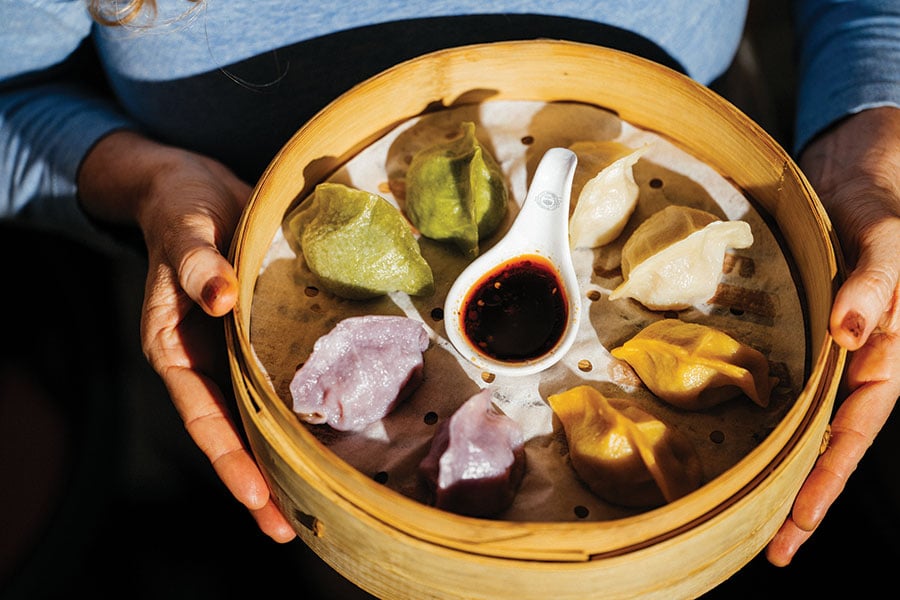
She patiently preps the dough and places it in a press machine. Le grabs the flat dough as it comes out and lines the pieces up. This is Le’s meticulous way of preparing one of the restaurant’s most ordered appetizers.
“Everybody loves our gyoza (dumpling). That filling over there is made with ground pork,” she explains.
For over 20 years, the Le family has operated their restaurant in a South College Center strip mall on Johnston Street in Lafayette. Initially, the family served Korean food. They tweaked the menu and rebranded in 2018.
Today, Osaka features Asian and Southeast Asian food, but Korean dishes remain.
“People don’t know what Korean food is, so we changed to more Japanese food,” she explained.
A cultural shift due to more international communication — à la the internet — introduced K-pop, kimchi and other Korean staples to the American public, and that led Osaka customers to request some of the foods that the Le family initially prepared.
“They are looking for Korean food. And we make traditional Korean food,” she said.
Kimchi tofu soup, jampong, braised ribs, spicy beef soup (yuk-gae-jang), bibimbap, beef bulgogi and garbi (Korean grilled short ribs) are a few of the Korean selections on Osaka’s menu.
Le — who was born and raised in Korea — utilizes an aunt’s recipes. Her aunt owned a restaurant in Korea.

“It was a big restaurant. So I learned from there, and I grew up in there with her,” Le said.
Osaka is successful, but it is not a singularly led operation. This restaurant is the result of a strong Pan-Asian partnership.
Le’s husband and lead chef is Quan Le, who hails from Vietnam. Quan Le developed his professional skills by working in restaurants.
“He loves to cook, and he loves the way people smile after eating our food,” Le said of her husband.
Beef short ribs — braised or grilled — are dishes the Les are proud to prepare and serve. Braised ribs are prepared in a Korean rib soup with a sauce, potatoes, carrots and onions, and served with a side of rice. Garbi is beef ribs grilled Korean-style.
Le said bibimbap is a dish that customers also order frequently. The dish consists of meat, steamed rice, stir-fried vegetables, Korean chili sauce, sesame oil and a fried egg that is placed on the dinner table in a hot stone bowl.
Sweet potato noodles are the base for japchae, which is another traditional Korean dish. The noodles are stir-fried with carrots, onions, broccoli, mushrooms and either beef, chicken, shrimp, tofu or vegetables.
The Les never miss a day at the restaurant. Why?
“We don’t trust somebody to cook, and the food could change, and the customer will not come back to enjoy another meal,” Le said.

To her and her husband, the whole experience of eating out is special. In fact, they have a phrase they share with employees — it is a restaurant mantra.
“We tell our servers that the customer tests our food three ways. Our new employees do not know what we mean when we say three-way,” Le said.
“A customer smells the food. Looks at it before it is placed on the table. Then they eat. So when the food is ready in the kitchen, the staff has to get it to the table right away.”
Le notes that everything done in Osaka is planned and intentional.
She wants customers to feel special, appreciated and satisfied, and to know what Korean traditional flavors are.
For Your Kitchen
Gochujang

A Korean fermented chili paste made from red peppers, glutinous rice and soybeans, gochujang brings dishes a signature blend of spicy, sweet, savory and deeply fermented flavor.
Kimchi

Korea’s iconic fermented vegetable dish, kimchi combines napa cabbage or other vegetables with chili, garlic, ginger and salt for a tangy, spicy, complex bite.
Sesame Oil

Toasty, nutty and intensely aromatic, sesame oil is a Korean kitchen staple, often drizzled over finished dishes or used to add depth to marinades and sauces.

Anatomy of a Bowl: Jampong
Broth
A spicy seafood broth is simmered to develop rich flavor, using the Le family’s closely guarded recipe.
Noodles
Thick noodles soak up the flavorful broth while maintaining a satisfying, slurpable texture.
Protein
Mussels, shrimp and squid combine with vegetables for a hearty mix of seafood and texture.
Garnish
Fresh green onions add a bright, crisp finish to the spicy seafood soup.
Osaka
2809 Johnston St., Lafayette
337-264-9997
@osakalafayette