Notre Propre Histoire Project at French Table in Rayne
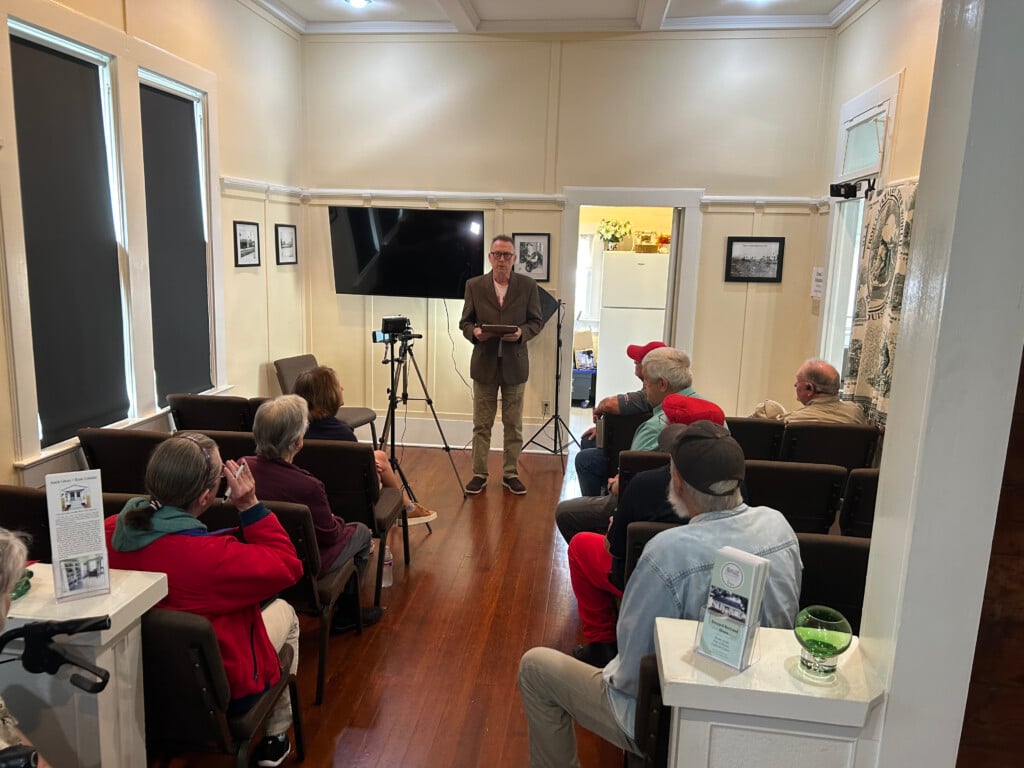
RAYNE, La. – On May 7, at 9:30 a.m., a special post-graduate research project, Notre Propre Histoire, took place at the regular French Table Gathering in Rayne.
According to Visit Acadia Parish, the City of Rayne hosts a weekly French Table on Thursday mornings at the Bernard Bertrand House (1107 The Boulevard). French Table is a community initiative by the Council for the Development of French in Louisiana (CODOFIL), which is Louisiana’s agency of Francophone Affairs.
CODOFIL shares on its website that there are over 40 French Tables throughout Louisiana. French Tables are free, informal community gatherings that keep Louisiana’s linguistic heritage vibrant by practicing French, Louisiana French and Louisiana Creole. The gatherings are open to all proficiency levels.
During the May 7 French Table Gathering in Rayne, the Notre Propre Histoire project documented the personal stories of Cajun and Creole individuals aged 62 and older to highlight individual life experiences and provide insights into the regional use of French and Creole language across Acadiana.
One of the project’s goals is to identify language variations even between local communities.
Tentative Academic Consultants
- Louisiana Dialects: Barry Jean Ancelet
- Professor Emeritus of Francophone Studies, University of Louisiana Lafayette
- Linguist Info: Monica Bonty, Phd.
- Professor, Linguistics, University of Louisiana Monroe
- Statistician Info: Whitney Sivils-Sawyer, EdD.
- Director, Education Technology, Louisiana Tech University
- Project Manager/Field Research: Brian Sivils, MA
- President, Alto Audio Inc.
- briansivils@gmail.com
Notre Propre Histoire Project Synopsis
While Cajun and Creole cultures throughout South Louisiana share many common elements, the geographic isolation of rural life in 19th and 20th-century American South led to the development of unique, localized speech patterns. Often, communities separated only by a
bayou, river or parish line used words and expressions unfamiliar to their neighbors.
Each participant will be invited to share three short stories or anecdotes:
- A humorous tale
- A somber memory
- A moment when they recognized their culture differed from the dominant American one
These stories will reveal not only personal histories but also the pressures faced by French-speaking communities—including the suppression of their language and broader heritage—especially in the post–World War II era of American modernization.
Participants will also complete a brief survey documenting their birth information, Cajun or Creole identity, and current residence. This will help us identify regional language variations across South Louisiana.
Testimonies will be recorded on video and transcribed. A searchable interface will allow researchers to filter stories by various parameters. Participants may choose whether their interviews are available to NPH subscribers. To ensure privacy, no identifying information will be included in the public database.