Camp Life on Boston Bayou
Only accessible by boat, this community offers a peaceful oasis in the Vermilion marshes

Years of camp life on Boston Bayou in South Vermilion Parish ranged from fishing and hunting to general recreation.
Julian Hinkley wasn’t a rich man but he and his wife owned property in Pecan Island where he fished and hunted to his heart’s content. The rustic camp lacked electricity and running water but a feast lay waiting just outside the screen door, not to mention the peace and quiet of living among nature.
“I keep telling people they were the richest people I know and they had no money,” said his grandson Todd Broussard.

Broussard’s Uncle Claude d’Augereaux had a similar idea. He built a one-room camp on Bayou Boston, a long stretch of water south of Henry in Vermilion Parish that eventually connects to the Intracoastal Canal and Vermilion Bay. d’Augereaux’s camp without the conveniences of modern life could only be reached by boat.
“They had a nice boat and they would shrimp and they’d spend the night,” Broussard said. “There was no electricity and no water. We later had fans and a generator but no A/C when electricity came in. But as a kid, we had a blast.”

Janice Bourgeois “Boo” Macomber of Abbeville, who for years worked as a chef and cooking instructor in Lafayette and New Orleans, purchased a camp on Boston Bayou in 1995 for $1,500 with a land lease from an oil company. Built in 1985, at the time her camp was the only one on pilings with seven-foot stairs. Her neighbors were a mix of newcomers like her and some like Broussard carrying camp life through generations.
Their commonality meant roughing things until wells could be built, facing severe weather such as hurricanes and coastal erosion and always requiring transportation over water. And yet, this small but vibrant bayou community remained steadfast in community.
“It’s a different way of life,” Macomber said.

The Boss–Stone
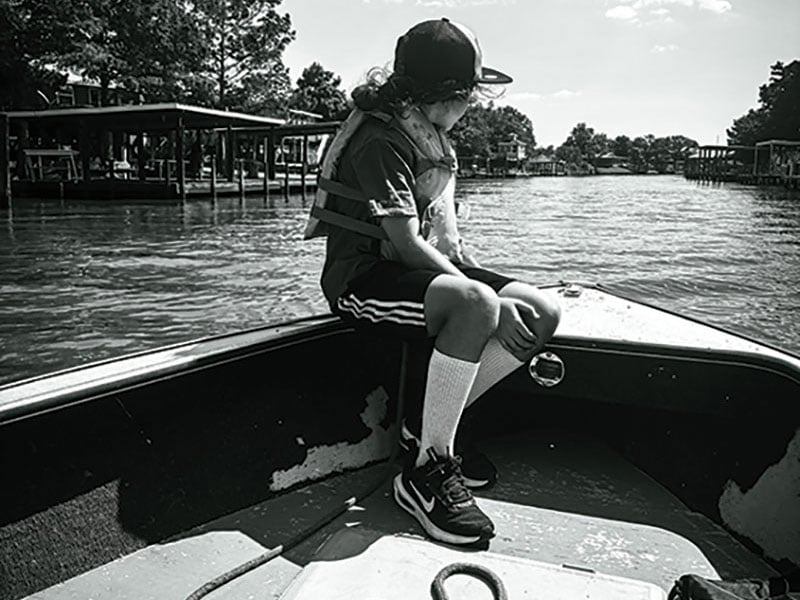
To reach the Boston (pronounced boss-stone) Bayou camps, drive south on La. Highway 331 south of Henry and Erath and turn west on La. Highway 688 to Don’s Boat Landing. There it requires a boat to travel the bayou. Broussard lives in Youngsville and drives 30 minutes from home to Don’s, then another 15 minutes by boat to his camp that he inherited from family, about seven miles south down the bayou.
“In 45 minutes, I can be at my camp,” he said.

Macomber takes longer, she says with a laugh, because she drives her boat slowly. “On a typical day, I load up the ice chest, go slow through the bayou. I usually go about 5 miles per hour. It’s a totally different deal.”
The name sounds Cajun but the spelling suggests a Northern origin. Since Macomber leases her land from an oil company, she suspected a corporation named the waterway. Warren A. Perrin, a Lafayette attorney and native of Henry whose family owns land on the bayou, has another explanation.
“My great grandfather Aristide Broussard had a nightclub nearby and the most popular bourbon was Boston Bourbon so the area and bayou took the name,” said Perrin, author of the history book “Vermilion Parish.” “Men on horseback would say in French ‘Let’s go get a Boston,’ so it was Franglais!”

Boston Bayou began as a small winding bayou that began near the Henry Hub plant, a distribution hub for a natural gas pipeline, and emptied at Vermilion Bay, Perrin said.
“About 1957 it was dredged and sort of straightened out and therefore became a canal because it was used by the trappers to reach the marsh,” he said.
There was always a boat dock on Boston Bayou, Perrin insisted. Through the years the company changed ownership but always name the dock after owners: Whitney Peltier’s Landing and Roy’s Boat Landing. Today, Don’s Boat Landing is named for Donald Ray Dugas who bought it about 1960. Dugas has since passed away but Don’s Boat Landing serves as a marina, bar and deli for its bayou customers, also offering boat launching, fuel and supplies.

Those who own camps along Boston Bayou insist it’s a different way of life, one of leaving the harried world behind and enjoying peace and relaxation.
“It’s known for its lively Cajun atmosphere, with features like live music, a spacious patio and a menu that includes burgers, chili dogs and bloody marys, making it a spot for both boating and socializing,” Perrin said. “Don’s wife Nelies Dugas is a dear friend and the bread pudding queen. They lived above the bar/store after Hurricane Audrey destroyed their house in 1957.”
Broussard, a Lafayette native, wonders if the bayou’s Cajun residents hail back further than his grandparents and if its history is more complex.

“I remember the old people talking about a resort at the mouth of the Boston Canal similar to the one at Chenier au Tigre,” he said of the summer resort built in 1913, adding that his grandmother was born at Chenier au Tigre. “That story is lost in history.”
One thing Broussard remembers as a child was cattle running freely throughout the area, owned by a large landowner near the bayou. His family would mostly visit in winter to forgo the heat of summer since they had no air conditioning.
“As a kid, we played,” he remembered. “Our parents drank beer, cooked. We had fun. As I got older I hunted, fished, cast netted. My favorite thing to do is cast net for shrimp.”
Weather was always an issue to the rustic camps that could easily be damaged in hurricanes and violent thunderstorms. Before Hurricane Rita in 2005, all the camps except for Macomber’s and a few others were on the ground, Broussard said.

“Everybody got wiped out but me and one other on the ground,” he said. “We had six to eight feet of water in the camp but it didn’t take it away. It’s still there. You’ve got to love it.”
“They call me the high priestess of the bayou because I only lost the stairs [in Rita],” Macomber explained. “You batter it [the camp] down and you just pray. Again, it’s another way of life.”
Repairing camps can be challenging since products must be brought in by boat, not to mention carpenters to do the work. That community mindset sometimes comes to campers’ aid.
“When I had to redo my dock, I called my friend and he said, ‘You buy the wood, I’ll bring the boat,’” Macomber explained. “He took a crew boat to camp. Afterwards, I called him up and said, ‘What do I owe you?’ and he said, ‘A six pack.’ That is why I love Louisiana.”

Today, most camps are elevated to avoid dangerous storm surge and wells have been built to provide running water. The lack of modern conveniences like electricity are a thing of the past.
“We have regular water and electricity which is huge because we’re by boat only,” Macomber said.
And maybe that’s not such a good thing. For a while, Broussard’s camp had everything but a telephone. Now that visitors come with cell phones, the peace of hearing only nature has been disturbed.
Still, Broussard goes as often as he can to enjoy the solitude that’s Bayou Boston.
“I used to go every weekend but now I go as often as I can,” he said. “It’s my second home.”

A Slice of Paradise
Macomber loves to invite guests to her camp, whether to fish from her dock or just sit on the swing and enjoy the marshes teeming with wildlife. It’s easy to spot duck, deer, alligators, otters and, unfortunately, wild pigs. Birders love the proliferation of eagles, ospreys, owls, pink spoonbills and soaring pelicans. Occasionally, butterflies arrive en masse.
Macomber, who was named an Acadiana Profile Best Chef in 2016, uses the opportunity to cook up fresh shrimp, crabs and fish for her guests, her favorite being shrimp and crab stew and “a lot of sauce piquant.” When her daughter visits, they always bring a sack of crawfish to boil. Occasionally she will throw store-bought items on the barbecue pit to slowly cook and enjoy later. Saturday nights, they turn on the radio — she doesn’t own a TV — and enjoy Classic Country Saturday Night on 97.3 The Dawg out of Lafayette.

“I tell my guests to do nothing, just sit down and let yourself go and feel nature,” she said. “When you’re out there, you’re glad to be there. You’re one with nature.”
Macomber believes she is the oldest member of the Bayou Boston community, earning the name “High Priestess of the Bayou.” Her 2009 cookbook and memoir, “Tastes, Tails, & Tales with The High Priestess of the Bayou,” details both recipes and stories from her time on the Boston.
The peace she enjoys on her isolated camp is how her camp got its name.
“It’s peace within,” Macomber said. “I was sitting there one day and thought, ‘I’m so at peace.’ That’s why I named it Camp Peace.”
“Growing up on the Boston Bayou taught me to turn inward,” said Macomber’s daughter, Colleen Macomber. “With no media distractions, I was forced to appreciate nature, get creative and learn to enjoy the sound of silence. That way of life shaped me deeply and has undoubtedly molded me into who I am today.”

Her cousin Anthony Russo agrees, describing his trips to Macomber’s oasis in poetic terms.
“What is peace worth, what value matrix can truly be used to define its value? Take one trip down the Boston to Camp Peace and you will see that there is no monetary value that can define the level of peace it brings. The camp is aptly called peace and sure does live up to its name. The hustle and bustle of life instantly stops as soon as you check for the plug in the boat for the third time. The launch is always a race to clear the space but also the race to hit the pause button on time and drift down south to where time itself truly stands still.”

Perhaps like Broussard’s grandparents, this little stretch of bayou provides more than material riches.
“Camp Peace is more than a retreat, it is therapy for the soul,” Russo said.