Louisiana’s Dog: The Catahoula Leopard Dog
A Homegrown Louisiana Dog Breed
Beyond the incredible natural biodiversity of Louisiana’s wild places, beyond even the — as the naturalist Charles Darwin once wrote of life’s dizzying variety across the planet — “endless forms most beautiful” that make up the prairies, forests, and terres neyées (“wetlands”) that we call home, Louisiana has also produced its fair share of “artificial forms” of life, kinds of plants and animals that have been guided, bred, or otherwise selected for by human hands; many varieties of — to mention only a few examples — riz (“rice”), canne à sucre (“sugarcane”), patates douces (“sweet potatoes”), pacanes (“pecans”), azélias (“azeleas”) and piments enragés (“hot peppers”), as well as animal breeds such as moutons de la côte du Golfe (“Gulf Coast sheep”) and chevaux créoles (“Creole horses”), have been developed in Louisiana and surrounding territories over the past few centuries, all adapted to our climate and serving to fill a number of niches and roles demanded by human society. Man’s best friend — in Latin, Canis lupus familiaris; in French, le chien (“the dog”) — is no exception: among the wide array of dogs big and small, in- and out-of-doors, that many of us are familiar with, there is one common breed that does indeed have the distinction of being Louisianian in origin: le chien léopard de Catahoulou (“the Catahoula Leopard Dog”).
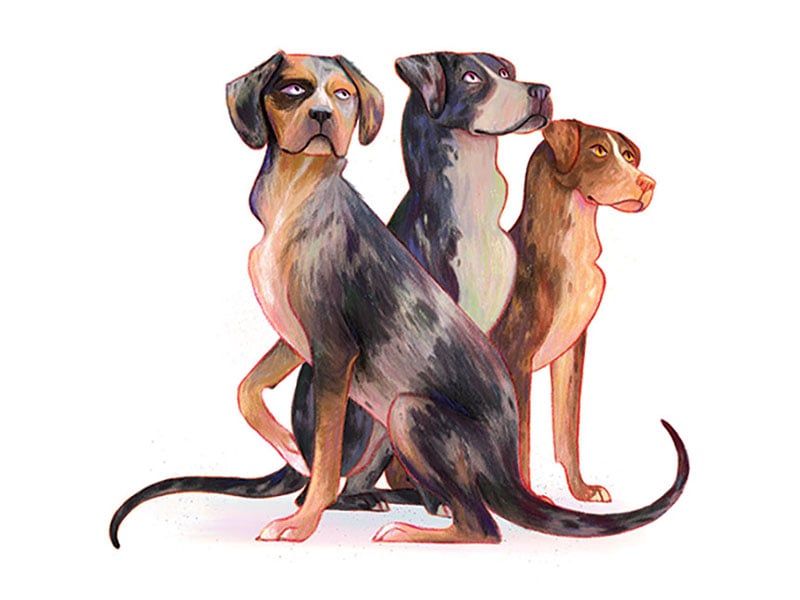
The Catahoulou (this ultimately Choctaw word, the name not just of this dog breed but also of a parish, two towns, and two lakes, is usually pronounced Catahoulou in French, as opposed to English Catahoula) is quite distinctive in its appearance: while sometimes sporting a solid-colored robe (“coat (of an animal)”), the prototypical Catahoula pattern is caille (“spotted, mottled”), variously colored blue, gray, white, red, or tan. The breed is also known for its striking eyes, which are often green, blue, or grey in color, sometimes very clair (“light”), even, famously, approaching the whiteness of a vitre glacé (“icy glass”). Like many traditional dog breeds, the Catahoula is a natural chien de berger (“herding dog, shepherding dog”), adept at driving and maneuvering the herds of sheep and cattle still common today in the Louisiana countryside, although the breed is also commonly trained as a chien de chasse (“hunting dog”), most often today employed in hunting cochons farouches (“wild hogs”).
The precise historical origins of the Catahoulou, officially named Louisiana’s state dog in 1979 by Governor Edwin Edwards, are not entirely known, but the breed’s beginnings likely trace back to the French and Spanish colonial periods. For the ultimate pedigree of the dog breed that we call the Catahoulou, some historians point specifically to the berger de Beauce (“Beauce Shepherd,” also called the Beauceron), a large sheep dog from the plains of north-central France that would have been brought over by French colonists, as a possible direct ancestor. Several of the Beauce Shepherd’s common coat patterns resemble those of the Catahoula Leopard Dog, and, like the Catahoulou, it is also one of only a few dog breeds commonly possessed of a double dewclaw on the patte (“paw, leg (of an animal, piece of furniture, etc),” leading many to believe that an admixture of the berger de Beauce with other European dog breeds, as well as, potentially, with native, pre-Columbian dog varieties, gave us the well-established Catahoula breed that we know today. In any case, the Catahoulou, like so many things in Louisiana, is unique, and is deserving of recognition as a true, créole (“homegrown, native”) Louisiana dog breed, one with an indelible place in our culture.