Traitement as an Approach to Health and Healing
Examining the role of traiteurs in Acadiana
Do not thank the treater. Do not pay the treater, though you may leave a gift. Treatments cannot cross a body of water. These are just a few traditional guidelines when requesting traitement (treatment) from a traiteur, or faith healer. Traiteurs can be sought to treat various ailments, often using prayers and herbs as part of their practice.
Dr. Dana David Gravot recalls her French-speaking grandmother and mother using treaters. However, when her interest in traiteurs began, not much seemed to be written about the topic. To learn more, she took a deep dive into her own culture, drawing on her family network to research this approach to wellness. “I would encourage people to go out and talk to their elders and ask about the stories they have,” Gravot said, citing the historically localized nature of traitement.
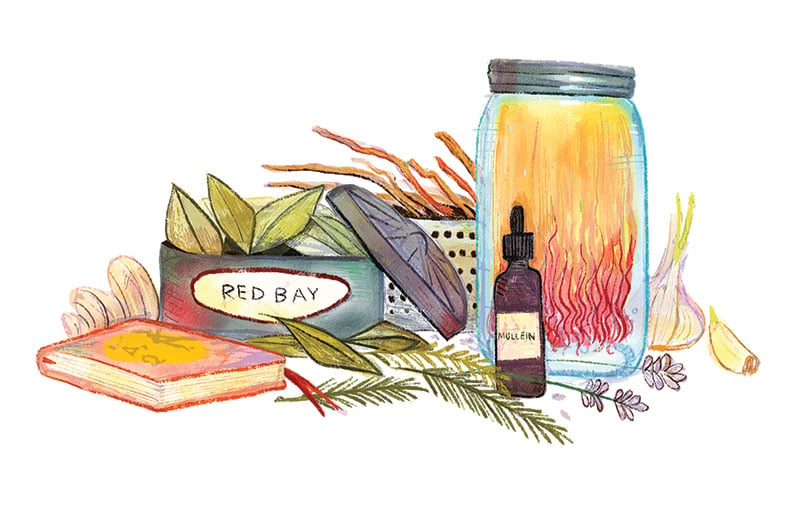
“It’s difficult to get a unified under-standing of traitement,” explained retired anthropology professor Dr. Ray Brassieur. For instance, some treaters might use specific items in their practice, including different plants and herbs. While speaking about the Healer’s Garden at Vermilionville, historian Jay Steiner noted the connection between modern medicines and medicinal plants that can be found at Vermilionville. The garden, started by Brassieur, is home to sassafras that can be used to treat stings, red bay to prevent chills and bristle mellow that can help with colds and whooping cough.
Another important aspect of this approach to healing is prayer. Colby Hébert was first asked to pray over a cousin suffering from colic when he was roughly 10 years old. When the ailment went away, he began getting asked to pray for others. The first prayer shared with him was from his grandmother, and as he got older, he met others who shared healing prayers with him. Some of the ailments Hébert has prayers for include asthma, poison ivy, warts, snake bites, rashes and burns. As someone deeply connected to his culture, Hébert believes “this tradition deserves immense reverence” and is something he wants to preserve by sharing it with others.
A rich history of traiteurs exists in Acadiana; however, like everything else, traitement is not immune to change. Today, some traiteurs heal over the phone, no longer confined to one side of a body of water. There is even a Facebook group where people can find treaters for specific needs. The path to becoming a traiteur has also changed, with some no longer waiting for prayers to be passed down to them, highlighting the evolving nature of traitement.
As it has been for generations, Gravot explains traitement as “a non-standardized approach to health and healing” allowing people to “seek health in different spots.”
Want To Learn More?
Read | Check out Dr. Gravot’s book, “Je jongle au bon Dieu quand je traite”: Traiteurs in Francophone Louisiana, written in both English and French!
Visit | Visit the Healer’s Garden at Vermilionville and ask about the toothache tree while you’re there!
Watch | Watch the lecture, “Traitement in Louisiana,” included in the In Your Own Backyard: series from the Center for Louisiana Studies.