French Music: A History Longer Than Memory
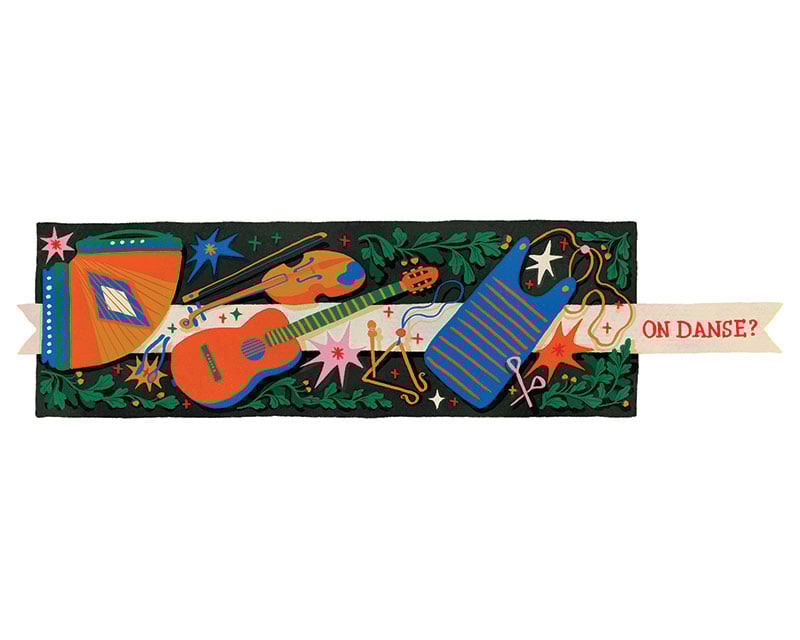
Louisiana’s musical landscape is extraordinarily rich and varied, and has been since the beginning: the land between the Pearl River and the Sabine has long been de la terre fertile (”fertile ground”) for the growth of a variety of rich cultural forms, a wide array of cultural currents and historic confluences all continually shifting and braiding across the prairies and swamps of South Louisiana, intercepting and diverging and producing a tangle of profoundly interrelated, yet profoundly unique, musical expressions. The French language, until recently the majority language across much of the country, has always permeated many of these musical currents, but among this diversity of French-influenced sounds, when we talk about la musique en français (“French music”), we are usually referring in particular to the traditional music of rural Southwest Louisiana, more specifically to the shared canon of dance-tunes performed on a core pair of instruments: l’accordéon français (“the single-row, diatonic button accordion”) and le violon (“the fiddle”), which are typically accompanied by un guitar (“a guitar”) and often further supported rhythmically by un tit fer (“a triangle;” also called une bastringue) or some other percussive instrument such as un frottoir (“a rubboard”) or a pair of culières (“spoons”). While a French band playing un bal (“a dance”) today can also include drums, electric bass, and steel guitar, it is the core instrumentation of accordéon, violon and guitar — the three musiques (“instruments”) that regularly make it off le band-stand (“the stage”) and into the front-room jams, front-porch visits, and indoor- and outdoor-kitchen soupers (“suppers”) where the music spends its free time — that form the foundation of Louisiana’s traditional French music.
Like many aspects of our culture today, however, our exact conception of what constitutes the “traditional” form of this music, joué à la vieille mode (“played the old-fashioned way”), only really crystalized towards the middle of the last century. Between l’accordéon, le violon, and le guitar, only the violon seems to have been popular before the year 1900; indeed, it seems clear that in many communities, the only non-percussive instrument present at all through the final quarter of the nineteenth century was the violon — two or three of which, with a rotation of violoneux (“fiddlers”) playing their best handfuls of valses (“waltzes”), valses à deux temps, one-steps, two-steps, reels, contradanses, polkas, mazurkas, côtiliennes, valsuriennes, galops, marches, lanciers, and other danses des autres fois (“old-time dances”), were enough to keep les danseurs (“dancers”) on their feet and moving around the floor. Around the turn of the century, though, accordéons imported from Germany began to grow in popularity, and soon came to dominate the bals de maison (“house dances”) and salles de danse (“dance halls”) of Louisiana’s prairies, a change in instrumentation that greatly affected the music we hear today: compared to a violon, the melodic possibilities on an accordéon français are quite limited, but the accordion’s enduring popularity continues to bearn witness to the esteem placed on the instrument for its volume, its durability, and, quite simply, for its belle musique (“beautiful music”) and for the unique excitement that just a few pushes and pulls on its soufflets et boutons (“bellows and buttons”) can inspire — dans les bonnes mains (“in the right hands”), of course.