Dried Shrimp: The Product of a Multi-Ethnic History
Les Chevrettes Chessées: How the Little Bags of Dried Shrimp in Louisiana Came to Be and How to Use Them
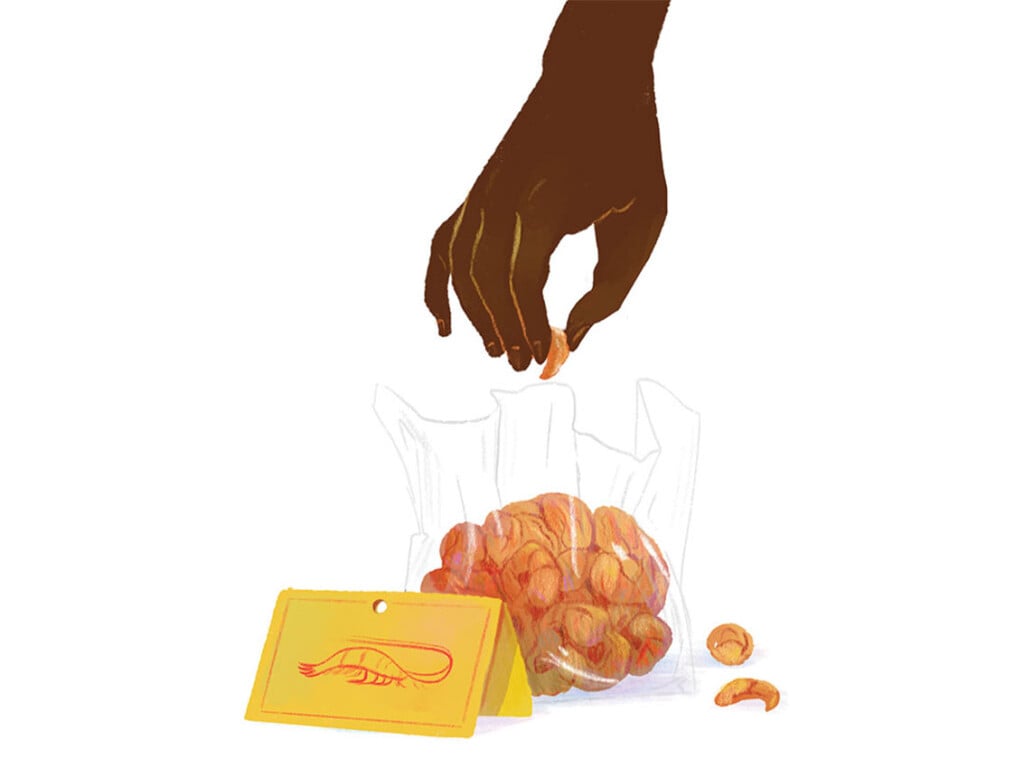
When I was young, I remember that, amidst the great variety of unfamiliar marchandises (“goods, merchandise”) that lined the shelves at the grocery store, there was one item in particular that would always sauter à la vue (“stand out”) to me: up front, near the register, would be found little bags of chevrettes chessées (“dried shrimp”). Like so many things at the grosserie (“grocery store”), these chevrettes were entirely foreign to our household, but unlike the strange frozen foods, exotic cheeses, packets of powdered brown and white gravies, and unfamiliar brands and preparations of the Hispanic section, these plastic bags of dried shrimp were very much the product of South Louisiana, with colles (“labels”) proclaiming them to be as such and sporting messages directed squarely at the Louisiana consumer.
My mother and father never touched these little packets of shrimp, though, and it wasn’t until college took me off of the Plaquemine Prairie and over to La Ville (“the city,” the name typically employed to refer to the city of New Orleans when speaking French; officially “La Nouvelle-Orléans”), and I began to meet people from that half of the country, that I encountered the demand driving the supply of dried shrimp: cuisiniers (“cooks”) looking to add extra concentrated shrimp flavor to their dishes; pêcheurs (“fishermen”) wanting a snack out on the boat; poor college freshmen with ramen and rice in need of seasoning — in short, a variety of people with teeth cut and palates raised on shrimp and other seafood in a way no Prairie Frenchmen ever is, and to whom these chevrettes chessées are often a common purchase.
The drying of food is an age-old preservation technique practiced by many cultures throughout the world, and although here in Louisiana it takes a distant fifth place to smoking, salting, and immersion in vinegar or in lard as a method of long-term food storage, in other places sharing tropical and subtropical climates similar to ours, le chessage (“drying”) is a very common way to preserve otherwise perishable foodstuffs such as meat and fruits. The storied history of dried shrimp in Louisiana in fact begins with the arrival of settlers from one such locale: the Philippines. In the eighteenth century, when both Filipinos and Louisianians — and the inhabitants of most of North and Central America as well — were concitizens of the Viceroyalty of New Spain, a significant number of families from the Philippines made their way to Louisiana’s shores. These Maniles (as they are called in French) quickly established themselves in the marshes of New Orleans’ hinterlands and took up much the same practices of subsistence fishing that had sustained them in their homeland, the drying of shrimp and other excess prise (“catch, haul (of shrimp, fish, etc)”) among them.
If dried shrimp has always enjoyed an importance in these Manile settlements, such as the towns of Cloche-Chênière (“chênière bell,” the French name for the site of Manila Village in Barataria Bay) and Saint-Malo (the first community of Asian immigrants in North America), it was later, with nineteenth-century Chinese immigration to the region, that the popularity of dried shrimp began to grow pour même (“truly, really”). By the turn of that century, the production of chevrettes chessées had reached a commercial scale, with significant amounts of Louisiana caught and dried shrimp being exported to Asian communities across the continent and even across the Pacific. And it was this later development of a shrimp processing industry and the consequent production of large quantities of dried shrimp that ultimately led to the establishment of significant local consumption of this product among the broader Louisiana public : not only in Asian households, but in nearly every grocery store and gas station, and among Cajuns, Creoles, Italians, Islègnes (“Isleños, Canary Islanders”), American Indians, and everyone else that calls the marshes of coastal Louisiana home — and beyond.